Year 3 and 4s:
Making Smarter Food Choices in a Media-Influenced World

We bodies are growing every day, and our bodies need different nutrients to help us stay healthy and strong. One of the main ingredients tackled about is protein daily protein intake.

You may hear a lot about protein through mass media, advertisements, fitness programs, supermarkets, and people around you. High-protein foods are often shown as a quick and healthy choice, especially for your growing bodies!

But does “high protein” always mean it is the healthiest choice?

In this project, you will investigate what is really inside popular high-protein foods. You will compare more processed and less-processed options, look closely at ingredients lists, and think about how mass media and fitness trends can influence the foods we choose in everyday lives.

Then , what is the problem? use the thinking emoji

High-protein foods are becoming more common. You may see protein bars, high-protein snacks and other protein products in supermarkets/shops, advertisements and on articles about health.

Because of the current influence protein has made, and because they are also advertised as high-protein, they can sometimes look like the healthiest option straight away.

But what else is inside them?

Can they be considered healthy?

So Let’s investigate:

  • What is really inside high-protein foods?
  • How are processed and less-processed foods different?
  • Why can some high-protein foods seem healthier than they really are?
  • Can a high-protein snack really replace a balanced meal?
  • How can we make smarter food choices in the future?
Assessment

What this project is about

What is this project about?

In this project, you will explore how we can make smarter food choices while still getting the nutrients our growing bodies need.

What will you do?

Activity 1

Judge & investigate

You will look at different foods and make your own first judgement about which ones seem healthy.

Then you will look more closely at the ingredient lists, compare what you find, and decide which foods may be more processed or less processed.

Activity 2

Design two snacks

You will explore ingredients that could be used in a healthy snack (a protein-based).

You will create two different snack ideas, draw and label them, and write your own recipe.

You will also check the nutrition information before choosing the design you want to make.

Activity 3

Make & evaluate

You will safely make your chosen snack

In small groups, you will test and give feedback,

You will then use this feedback and design goals to decide what worked well and what you could do better next time.

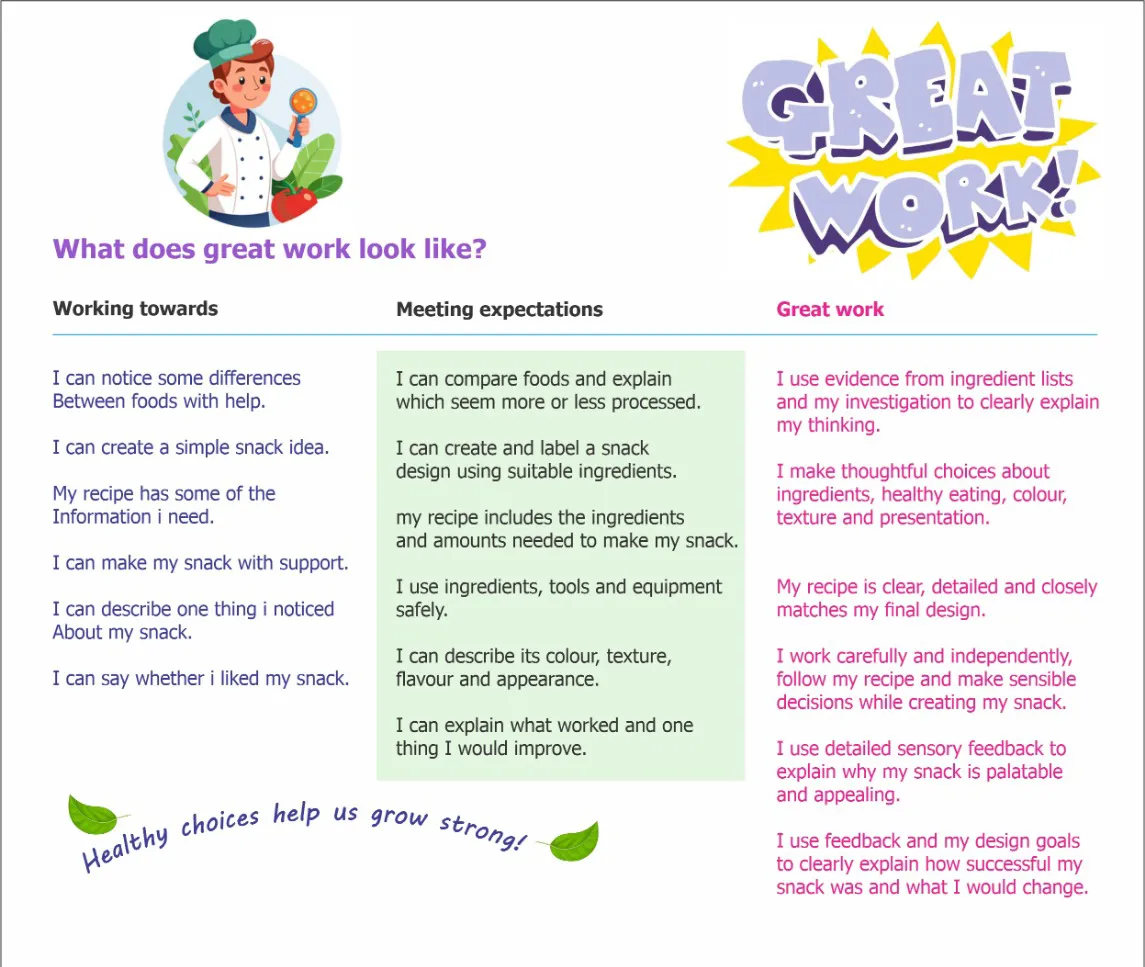
Success criteria

  • I can use evidence to compare different food choices.
  • I can explain which foods are more or less processed.
  • I can choose suitable ingredients for my snack.
  • I can label my final design.
  • I can include a recipe with measurements.

Activities

Activity 1 2 hrs 30 mins

Investigate & empathise

Knowledge and understanding

AC9TDEK04 – Describe the ways food can be selected and prepared for healthy eating.

Process and production skills

AC9TDE4P01 – Collecting information that will help me design something to make a smart, healthy food choice.
I am learning to
  • Compare different food choices
  • Look closely at ingredient lists & nutrition info
  • Explain if a food is more or less processed
  • Use evidence to explain my thinking

The teacher places five different food packages (with labels) on the investigation table. For example, you might see:

Plain yoghurt
Regular milk
High-protein bar
Protein chocolate
Protein cookie

Do not turn the packets around yet (the ingredient list), only look at the food and the front of the packaging.Ask yourself,

  • Are they all a healthy food choice (yes / no)?
  • If not, which one is the healthiest choice?
  • Could any of these replace a meal?

Now choose two food types and finish the label given to you:

I choose   because    .
(It might be something written on the packet, the way the food looks, something you’ve heard about it before, or something seen on social media.)

In groups of 2–3, share your ideas. Did your partner choose something different? What made each of you think a choice was healthy or unhealthy?

Now that you’ve made your own judgement, watch two short videos about processed and less-processed foods.

Watch 1
Watch 2

This time, investigate the ingredients on the actual label. For each product, look for familiar whole-food ingredients and ingredients that sound more technical or unfamiliar. Then rate it out of 5 stars, showing your thinking about whether it is less processed or more processed.

Rate each food: (1 = more processed · 5 = less processed)

Complete the activity sheet as you go.

My final statement
Out of the foods I investigated, I think    is the best choice for healthy eating because   . I think   is more processed because   . One thing I noticed about high-protein food was   . Now my thinking has changed because   .
View/Download Form
Activity 2 3 hrs

Define & ideate

Knowledge and Understanding

AC9TDE4K04- Describing the ways food can be selected and prepared for healthy eating. And also, how food can be presented in ways that make it palatable (this could include colour, texture, shape).
I am learning to
  • Choose ingredients that can be used for healthy eating including healthy protein choices
  • Use mostly less processed ingredients where possible
  • Make a healthy snack that is palatable.

Process and production skills

AC9TDE4P02- Generate and communicate design ideas using drawings, labels and clear design decisions.
I am learning to
  • Create two snack ideas.
  • Draw my ideas clearly.
  • Label the different parts and ingredients.
  • Use information to compare my ideas
  • Explain why I chose my final design.

Now you know more about processed and less-processed foods through the knowledge gained through activities 1 and 2. Your next challenge is to design a protein snack that supports healthy eating and is still something that looks appetising. Look through the ingredients available for your food. Example

IngredientCottage cheese
What could it add to my snack?Protein and a creamy texture

Before drawing anything, choose the things that matter to your design:

  • Made mostly from less -processed ingredients, A good source of protein is available, Food is appealing to the children as well as suitable for the children (natural ingredients like coffee is avoided).

Create your own snack ideas.- This should be a proper design with colours and labels/not a tiny sketch. (use the activity sheet provided).

Draw the snack
Name the snack
Colour each part
Identify the protein

Complete the activity sheet based on your gained knowledge throughout.

Enter your recipe/the ingredient amounts into the nutrition website _the website generates nutrition information based on your design.

Happy Forks — Nutrition Analyzer happyforks.com/analyzer/result
I think my snack is a healthy choice because of   . One thing I might change is   because   .
View/Download Form
Activity 3 3 hrs

Prototype, test & evaluate

Knowledge and understanding

AC9TDE4K04- Students describe food using their senses and Think about what influences them
I am learning to
  • How my snack looks like.
  • Decide if I have made a smart healthy choice.

Processes and production skills

AC9TDE4P03 - Select and use materials, components and tools to safely make my designed solution. AC9TDE4P04- Use design criteria to evaluate and improve my designed solution.
I am learning to
  • Test the finished work.
  • Collect feedback from peers.
  • Decide what changes could be made

You have investigated the problem and designed your own snack, now its time to make it.

Choose the design out if the two designs you made that you think best meets your snack goals.

Before you start making it:

Wash your hands
Tie back long hair
Clean your work area
Read your recipe
Use equipment safely

Measure your ingredients carefully and make your snack as close to your design as you can.

This is your prototype-the first real version of the snack you designed.

Now take a proper look and see if you notice anything that turned out differently from what you planned.

Your snack might look good to you, but what will other children think?

Work in groups of 5- each student will share their snack with the group and receive feedback (by looking, due to different dietary requirements).

When you test someone else’s snack, think carefully about what you notice (the colour, the smell, the healthiness from the knowledge you gained, the overall look)

For each snack you review, complete a short feedback card. Each student will collect 5 feedback cards for their prototype.

Now decide how successful your snack really is. Look back at your:

Original design
Your recipe
Finished prototype
Your feedback
Your goals

Complete the evaluation table, then write your final evaluation.

The feedback from my group showed me   . I think children would choose my snack because   .
View/Download Form
Worked samples

Student work across the project

Evidence of learning collected from each activity - from first impressions through to the final evaluation.

1

Activity 01

Investigate & empathise


View/Download Form
2

Activity 02

Define & ideate


View/Download Form
3

Activity 03

Prototype, test & evaluate


View/Download Form
Teacher information

Project overview & curriculum

Purpose

The purpose is not to teach students that every processed product claiming to be healthy or high-protein is unhealthy. Instead, students investigate different foods, examine ingredient lists, compare less-processed options, and use what they find to make their own decisions.

Research shows that food marketing can influence the food choices of children and adolescents, which makes this a relevant real-world context (Gascoyne et al., 2021; Mc Carthy et al., 2022).


Design-thinking process

Snapshot FOR PLANNING
TitleMMaking Smarter Food Choices in a Media-Influenced World
Year levelYears 3–4
SubjectDesign & Technologies
ContextFood specialisations
Duration8 hrs 30 mins
Structure3 linked activities
Final product: a student-designed healthy protein snack that is made, tested and evaluated.

Curriculum connections

Content descriptorStrandWhere it’s addressed
AC9TDE4K04
Describe the ways food can be selected and prepared for healthy eating, and how it can be presented to be palatable.
Knowledge & understanding Activity 1 - compare foods and examine ingredient lists for more/less processed. Activity 2 - make a snack palatable and appealing; enter the recipe into a nutrition calculator.
AC9TDE4P02
Generate and communicate design ideas and decisions using attributions, technical terms and graphical techniques, including digital tools.
Processes & production Activity 2 - create two snack ideas; communicate through drawings, labelling and the activity sheet; compare and justify the final choice.
AC9TDE4K03
Describe the ways of producing food and fibre.
Knowledge & understanding Activity 3 - use the final design to produce the snack.
AC9TDE4P04
Use given or co-developed design criteria, including sustainability, to evaluate design ideas and solutions.
Processes & production Activity 3 - return to the design goals, judge whether criteria are met, and use peer feedback to identify improvements.
Assessment

Formative assessment in activities 1 and 2

  • First impression responses
  • Group discussions
  • Final reflection statements
  • Labelled drawings
  • Comparison of design ideas
  • Justification of the final choice

These responses allow the teacher to see students’ existing ideas and identify any misunderstandings before students begin designing.


Summative assessment in activity 3

  • Safe use of tools and equipment
  • The finished snack prototype
  • Peer feedback
  • Evaluation against the design criteria
  • Suggested improvements

The final assessment therefore considers the food students create and the thinking that led to the final solution.

Differentiation and Inclusion

Students who require additional support may use:

  • Visual ingredient cards
  • Partially completed tables
  • Examples of labelled drawings
  • Pre-measured ingredients.

SStudents who cannot safely taste or handle particular food (food allergies, cultural food practices, dietary needs) can demonstrate their learning through drawing, designing and observing photographing.

Learning Theories

This project draws on different learning theories to support students as they move through each activity. Project-based learning gives students a real-world problem to explore and allows them to work towards their own final product. By guiding students through investigating, creating, testing and improving their ideas, design thinking supports this project (Gallagher & Thordarson, 2020)

Bloom’s revised taxonomy can also be seen as students move from understanding and analysing information to creating and evaluating their snack (Karthwohl, 2022), while Garder’s Multiple Intelligences is also reflected through discussion, drawing of the snack ideas, and the final reflection (Garder, 1983).

Personal Reflection

Why I planned this project

When I started planning for this project, I wanted to choose a topic that students could connect with in, real life. I work as an Education support staff member in a school, and because I also travel on public transport after school a lot, I hear students talking about things they see online, like food trends, fitness culture, and products that are advertised as being “high protein” or “meal replacements”, . I realised that these messages can be taken very quickly as facts, especially when students do not have enough knowledge around this to question themselves. That made me want to bring awareness from a young age to help students make smarter food choices by looking beyond the front of a packet or the advertising claims. Research also has shown that food marketing can influence food choices of children, making this s a relevant issue to explore (Gascoyne et al., 2021).

Project-based learning matched the idea because I did not want students to just listen to information about making smart food choices. Instead, I wanted them to investigate the issue for themselves. In Activity 1, students are introduced to a broader idea and begin questioning their first impressions of different foods. Activity 2, students create their own snack ideas. This is where the learning moves beyond thinking whether a food is just healthy, since students also have to consider how the snack could be made more visually appealing through its colour, texture, shape or presentation. This links directly to AC9TDE4K04 and its elaboration about food creativity (Australian Curriculum, Assessment and Reporting Authority [ACARA], 2022). In activity 3, students make one of their designs and receive feedback from peers, which helps them decide what could be improved, which connects with the role of feedback in supporting students' further learning (Hattie & Timperley, 2007). Overall, the activities build on each other.

Design thinking helped me think more carefully about how students could move from having an idea to actually developing it into something they could test. I included two different snack designs before students chose one because I wanted them to compare possibilities ,rather than settle on the first idea that comes to mind (Gallagher & Thordarson, 2020). Bloom’s Taxonomy also help me check that the thinking became more complex as students move from understanding and comparing information to creating their own solution and then evaluating their success (Krathwohl, 2002). Furthermore, Gardner’s Multiple Intelligences also influenced the variety of tasks, as students use drawing, discussion, food preparation and written reflection to show their understanding in different ways. (Gardner, 1983).

Research suggests that e-portfolios can support formative assessment and make students' learning process more visible over time (Gun-Tosik et al., 2023). Therefore, if I were to run this project again, I would replace some of the separate worksheets with a simple digital portfolio where students could keep their first ideas and designs, feedback and reflections.
References

Reference list

  1. Australian Curriculum, Assessment and Reporting Authority. (2022). Australian Curriculum: Technologies (Version 9.0). australiancurriculum.edu.au
  2. Gallagher, A., & Thordarson, K. (2020). Design thinking in play: An action guide for educators (1st ed.). ASCD.
  3. Gardner, H. (1983). Frames of mind: The theory of multiple intelligences. Basic Books.
  4. Gascoyne, C., Scully, M., Wakefield, M., & Morley, B. (2021). Food and drink marketing on social media and dietary intake in Australian adolescents. Appetite, 166, Article 105431. https://doi.org/10.1016/j.appet.2021.105431
  5. Gonen, E. (2019). Tim Brown, Change by Design (2009). Markets, Globalization & Development Review, 4(2). https://doi.org/10.23860/MGDR-2019-04-02-08
  6. Gün-Tosik, E., Atasoy, B., & Yüksel, A. O. (2023). The role of ePortfolios in formative assessment: A systematic literature review. Journal of Measurement and Evaluation in Education and Psychology, 14(Special Issue), 299–319. https://doi.org/10.21031/epod.1276063
  7. Hattie, J., & Timperley, H. (2007). The power of feedback. Review of Educational Research, 77(1), 81–112. https://doi.org/10.3102/003465430298487
  8. Kabayadondo, Z., & Goldman, S. (Eds.). (2017). Taking design thinking to school. Routledge.
  9. Krathwohl, D. R. (2002). A revision of Bloom’s taxonomy: An overview. Theory into Practice, 41(4), 212–218. https://doi.org/10.1207/s15430421tip4104_2
  10. Mc Carthy, C. M., de Vries, R., & Mackenbach, J. D. (2022). The influence of unhealthy food and beverage marketing through social media and advergaming on diet-related outcomes in children — a systematic review. Obesity Reviews, 23(6), e13441. https://doi.org/10.1111/obr.13441
AI acknowledgement

I acknowledge the use of ChatGPT to assist with completing the Activity 2 answer sheet only. The Activity 2 worksheet was originally created by me in CorelDRAW. I provided the worksheet, the recipe details and the other information to be included.

Prompt used: “Use the CorelDRAW activity worksheet created by me and fill it in according to my instructions, using the recipe and the snack-design explanation.”